Why We Stopped Promising Confidence and Built the Swedish Activation Method™
 Bojana
Every Swedish course promises confidence. We deleted it from ours and replaced it with the Swedish Activation Method™. This is why.
Every Swedish course promises confidence. We used to as well.
Our homepage said it. Our course descriptions said it. Speak Swedish with confidence. It's probably the most common promise in language teaching. You see it everywhere. On websites, in ads, in course titles. Build your confidence. Finally speak Swedish with confidence.
We deleted it. From everywhere.
Not because confidence doesn't matter. It does. But confidence isn't something a course can give you, a teacher or a coach can train, or more speaking practice can fix on its own. It's what happens AFTER something else falls into place. Confidence is the outermost layer. Without solid ground underneath, it doesn't last.
If you're learning Swedish and don't speak it confidently, the problem isn't your confidence. It might feel like a personality trait you're missing. It's not. It's a skills gap. As long as a course, a teacher, or a coach frames it that way, they probably don't have a practical solution. They just have a word that sounds good.
You're confident in your first language. Not because someone taught you to be. Because you have the tools, the experience, the understanding of how your language works in different situations. You know what to say, how to say it, and what the person in front of you expects to hear. Confidence came from that. Not the other way around.
Swedish is no different. And no amount of willpower or "just speak more" will help if you can't have the conversations you want to have, be yourself in them, and feel that Swedish actually works for you.
Feeling confident and having the skills that confidence is built on aren't the same thing. One you can get from a pep talk. The other you build. One fades. The other one stays.
Why we teach Swedish differently
Natalia and I didn't grow up speaking Swedish. We came to Sweden as adults, from Russia and Croatia. And we've felt the exact thing our students describe. Comfortable in one conversation and unsure in the next, even though our Swedish was the same. The difference was never confidence. It was whether we had what we needed for that particular situation.
I can only speak for myself here. When I was learning Swedish, I was never completely free of it. I could feel frustration, disappointment, insecurity. But I couldn't let those feelings stop me, because then I wouldn't learn the language. That was the whole point with my experience. And it's the whole point with what we teach: not that you'll never feel unsure, but that you'll have what you need to stay in the conversation anyway.
We're not unsure anymore. But we remember exactly what it felt like. And that's why we understand our students the way we do.
Most Swedish teachers and coaches grew up with Swedish. We didn't. We learned it here, while building our careers and our lives at the same time. We know what our students go through because we went through it ourselves. We've been there.
"I've had many Swedish teachers who are native speakers. They could never really understand why I kept getting stuck. But Natalia could. Because she's been stuck in the same places herself."
— Priyanka Marigi, IT Engineer, India
We always taught this way. We had our own approach, our own internal language for it. But we didn't think of it as something unusual. It was just how we worked.
Our students were the first to notice. Going back almost twenty years, we kept hearing the same thing: 'Nobody has ever taught me Swedish like this.' At some point we had to take it seriously. What we thought was normal turned out to be rare.
But publicly, we never said it. We used the same word everyone else uses. Confidence. Because that's what you're supposed to say.
We had a method. We always had it.
And everywhere we taught, the same moment kept appearing: SFI, Komvux, university, private language schools, one-on-one, corporate programs. Online and in classrooms. A1 to C2.
Someone who had studied seriously, who could read, write, pass a test. But when Swedish showed up in real life, unscripted, at normal speed, something stopped working.
That moment has a structure. In our course Stay in Swedish, we call it the Waiting Gap and train it specifically.
The Swedish Activation Method™
That's what we call it. It's what we've always done.
We taught with this method for over 22 years before we had the words for it. Over 3,000 students from more than 100 countries. That's how the method was built and refined.
Ask our students what they learned and they'll tell you, specifically. And they use it in conversations nobody prepared them for. That's how we know it works.
The simplest way to describe it: we close the gap between the Swedish you know and the Swedish you can use. Whether that's a meeting at work, a conversation with your Swedish partner's family, or a phone call you've been avoiding.
Every approach you've tried did something real. The classroom gave you rules. Self-study gave you input. Speaking more gave you exposure. But none of them trained you for the moment Swedish has to work in real life, with real pressure, without a script.
That's the difference between a tip and a system. A tip works once. A system changes how you understand Swedish so that it works in every conversation, even the ones you didn't prepare for.
We know exactly what needs to fall into place before confidence follows. What actually builds confidence in Swedish is having specific skills. That's what our Swedish Activation Method™ is designed to do. It works in three steps: Decode, Navigate and Activate.
Decode is where the pieces come together. Most courses teach grammar, vocabulary, and pronunciation as separate parts. Under pressure, you're racing through all of them, trying to find the right word and the right form at the same time. Decode connects them into one system so that what you know is available when you need it.
Navigate is where you learn to keep going. When you're mid-sentence and the word you need won't come, Navigate trains you to find another way through instead of stopping or switching to English.
Activate is where you build judgment through guided practice with intentional feedback: what works, what doesn't, and why. Over time you rely less on us, your teachers, and more on yourself. That's when Swedish is actually yours.
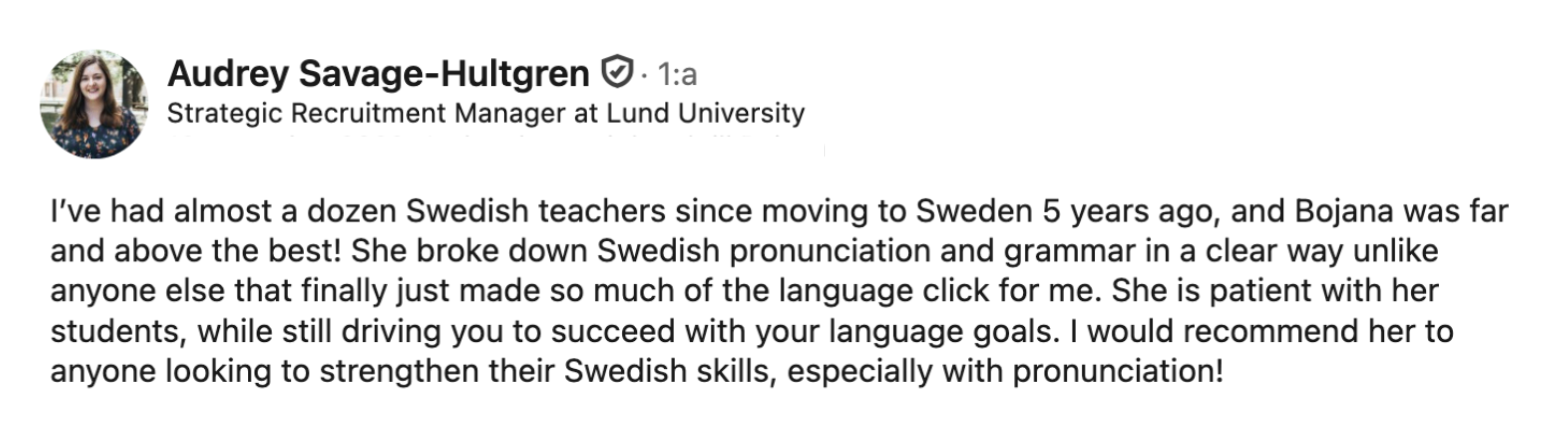
We're certified Swedish teachers (legitimerade gymnasielärare i svenska som andraspråk), the highest formal qualification for teaching Swedish to adults in Sweden. We studied the language, how it works, and how adults learn it. This method is built on that training. It was refined through our own experience learning Swedish as adults, and through working with professionals and internationals who needed Swedish to live and work in Sweden.
It doesn't matter what someone calls their approach. Teaching, coaching, a method, a program. The question is whether it still works when the moment is completely new. If it only helps in the situations you practiced, it isn't a system. It's preparation for a script.
If you want to experience what Decode feels like in practice, our free pronunciation course is built on the same principle. One feature of Swedish pronunciation that changes how you hear and speak it. Nine lessons. 35 minutes.
What it actually looks like to speak Swedish confidently
Almost every Swedish teacher and coach promises confidence. Almost every Swedish course leads with it. When everyone says the same thing, the word loses its weight. But confidence is real when it's built on something solid.
That doesn't mean we don't help our students speak Swedish confidently. We do. We always have. The difference is that we have our own definition and our own method.
We didn't stop using the word confidence. We stopped making it our main promise. When our students feel confident now, it's because they actually have the skills for the conversations they want to have.
We still use the word. Our students do too. The difference is they can describe exactly what has changed for them after working with us and why.
Confidence, the way we see it, is something that grows. It's not a switch. It's not a personal trait. It's what happens when you can have the conversations you want to have, be yourself in them, and feel that Swedish works for YOUR life in Sweden. Not because someone promised you a feeling.
Because you built something real underneath it. And you can tell someone exactly what changed.

"After three different Swedish courses and scoring high on every test, people still couldn't understand me when I spoke. I knew Swedish on paper. I just couldn't use it. Finally, I found teachers who could show me exactly where it was breaking down and give me strategies that worked in real conversations. For the first time, I stopped studying Swedish and started using it."
— Yaqin Chen, IT Engineer
That's what we replaced "confidence" with. Not another promise. A method. Not another word that sounds good. A system that our students can tell you about themselves.
Have you been promised confidence?
If you've ever been told to "build your confidence" in Swedish, or to "finally start speaking Swedish with confidence," of course you want that. But when you're actually in the moment, trying to say the right thing in Swedish, "be confident" doesn't help. Because the promise was always about how to feel. Never about what's missing.
Confidence was never the main problem. Nobody else looked at the other reasons your Swedish actually stops working. And those reasons can be identified and trained. That's a skills problem. And it has a solution.
That's what the Swedish Activation Method™ is for.
If you want to experience how we teach, our free pronunciation course is a good place to start. Nine lessons. 35 minutes.