You Understand Swedish.
The Problem Is the Moment
You Have to Use It
You don’t need more Swedish.
You need to train the moment where it falls apart,
so you actually answer.
You’ve Had This Moment
Someone speaks to you in Swedish. You understand.
But when it’s your turn to answer, your Swedish disappears.
You switch to English and later you think: why didn’t I just answer?
This usually isn’t a vocabulary problem. It’s a training problem.
You might even have the certificates that say you know Swedish. SFI, Komvux, maybe more. Passing a course and using the language in a live conversation are two different skills.
Courses prepare you for the test. They don’t prepare you for a real conversation.
“I have to change to English,
because I just couldn’t keep the conversation going.”
“I’ve been learning Swedish for some time, but I understood that I don’t speak it on everyday basis. I understood everything that teachers are saying I could speak to the teachers. But when I went to the store or talked to a real Swede in real life, I understood that I have to change to English, because I just couldn’t keep the conversation going.”
It Has a Name
It’s one specific moment.
The conversation turns to you. Someone looks at you and waits.
Your thoughts race. You overthink. You reach for English,
because English is faster and the moment doesn’t wait.
That isn’t laziness, and it isn’t about being brave enough.
The old tool is fast and the new one is slow. Under pressure, the brain takes the fast one.
It happens with the neighbour in the stairwell. At school pickup.
In the fika talk you smile and nod through.
The setting changes. The moment is the same.
The narrow window between hearing Swedish and answering under real pressure.
Elaine read our LinkedIn post about the Waiting Gap and wrote this:

“Oh, my gosh – I have never seen the struggle so clearly articulated in words!
People ask why I don’t speak more Swedish and I never know how to answer (in English or in Swedish 😂) but this is exactly it. So it has a name – the Waiting Gap. That helps to know it’s not just me!
It happens to me all the time. It’s so frustrating because as soon as I walk away my mind literally races with all the things I could have said, but just couldn’t conjure up the Swedish in the moment.
So – how do we overcome it? 🙃”
And now that it has a name, it’s something you can train,
not just something you live with.
You’ve Been Meaning to Fix This for Years
This has probably been on your list for years.
It’s not an emergency, and that’s exactly the problem.
You manage in English, so it waits:
next month, after the summer, when work calms down.
Then you start noticing how many of these there are in one week.
The teachers at förskola and school, the parents at pickup, your kid’s friends at your place. All of it in Swedish, and you can’t quite follow any of it.
A letter from Skatteverket on the table, and you reach for the translation app again.
Lunch, fika, the team meeting. It switches to Swedish and you go quiet with something to say.
Everyone around the table is speaking Swedish. You’re following along, and not saying anything.
None of these moments are new. That’s the point.
They keep happening, every time, you tell yourself the same thing:
I should really do something about this.
Stay in Swedish is for people who’ve decided to do something about it now.
Nobody Trained You for This Part
Gave you structure and rules. But in class, people wait for you. In real conversations, they don’t.
Gave you practice and a sense of progress. But without feedback, you can’t tell what holds up under pressure.
Helped in some ways. But without targeting this specific moment, the freeze stays exactly where it is.
You’ve been told to be braver, to push yourself and just speak.
But the bravest people freeze too. So do the people who pass every exam, have the vocabulary, and speak well in class.
None of these paths were built for the Waiting Gap.
They all assume the same thing: that if you know enough Swedish,
or simply speak it often enough, the moment will take care of itself.
It won’t. That’s why it hasn’t.
“I’ve never seen such an offer as a Swedish course.”
“It was quite original, unique, and a bit bold what you guys were offering. You openly say: we’re not going to teach you intensively grammar. We’re going to help you become more comfortable in day-to-day Swedish. I’ve never seen such offer as a Swedish course.”
Another year of being switched to English.
The Swedish Activation Method™
Decode. Navigate. Activate. Three parts, each aimed at a different piece of the Waiting Gap, taught in the order it actually breaks down.
Decode
From confusion to clarityYou see how the pieces of Swedish connect, and the unwritten rules underneath them. When someone speaks, you’re working with a system, not searching through fragments.
Navigate
From clarity to directionYou have seconds, not minutes. Navigate trains you to choose what to say under real pressure. Not the perfect sentence. A clear one.
Activate
From direction to independenceYou practice with real situations from your life and get feedback on what worked, why it worked, and how to do more of it.
You Understand Every Word and Still Miss What’s Happening
Part of what makes the Waiting Gap so hard to cross is that
Swedish conversations follow rules nobody wrote down for you.
You can hear every word and still miss what’s being said.
Sonya, who did the program this spring, put it better than we can:
“You don’t really need a lot of words.”
“I thought that I don’t have enough words, that I can’t remember and come up with the things I want to say. But then I realized that this is not true. I can actually talk. I just need to know what’s the code? What are people expecting me to say? How can I steer the conversation in the right way? You don’t really need a lot of words. You just need to know how that works.”
That’s Decode and Navigate: reading what a moment expects,
and choosing what to say in it.
“I don’t really need to be this perfect.”
“I think the key was that when I understood what was needed from me in these different setups, then I was like: ’Okay, I don’t really need to be this perfect, or have this perfect Swedish, to interact with the people in these different situations.’ So I think that was kind of the key really.”
10 Weeks. Two Phases
You learn specific tools for finding your way
through a conversation and staying in Swedish.
We don’t just correct your Swedish.
We show you what to do instead, and why.
The lessons give you the system: how Swedish actually works in real conversations, taught hands-on in a small group. The practice sessions are where you try it out on real-life situations, practise how to respond, find out what works, and get our feedback on it.
By week ten, Swedish is something you use,
not something you get ready for.
Most courses end before you find out whether it works.
This one doesn’t.
You’ve been using this in your real life since week one. These four weeks are where it settles. You have the tools now, and this is the phase where using them becomes normal. You use them in your real conversations, and each week we go through what happened together: what worked, where you got stuck, what to do differently.
Taught by us. Every session.
Not hired coaches, not assistants. Bojana and Natalia, certified Swedish teachers with 22+ years of experience, and the creators of this program.
in the weeks right after a course ends.
This is the phase that stops that from happening.
A Private Pronunciation Session. Included.
You leave knowing exactly what to work on.
Included in the course price.
Every participant gets one.
After the program you get an individual session with your teacher, who has spent over 15 years specialising in Swedish pronunciation and is certified to teach Swedish as a second language. We go through your pronunciation together and you leave knowing what to work on.
- What matters for being understood, and what is just accent.
Clear advice on both. - Priorities chosen for your first language. Based on research into what speakers of your language need in Swedish. Not a generic list.
- What makes your Swedish easy to follow, and spoken Swedish easier to understand. What you learn to say, you also start to hear. Almost no Swedish courses teach this.
You find out what stops people understanding you,
and what to change so you can stay in Swedish.
“No one ever told me about this.
For me it was mind-blowing.”
“No one ever told me about this, the long consonant, and how to see which word is the important one that the people need to hear. For me it was mind-blowing. It was fantastic.”
What Your Swedish Looks Like After Ten Weeks
You stop switching to English automatically. Conversations stop feeling like tests.
Someone speaks to you at fika. You answer. They respond.
You respond back. The conversation continues.
You’re on the phone. Someone speaks Swedish. You follow. You reply. You stay in it.
Your partner’s family asks you something at dinner.
You answer in Swedish. Not because you rehearsed it.
Because you know how to find your way through the conversation.
Not because your Swedish is perfect.
But because it works.
”I feel like more in the community, that I can speak to anyone and it’s not a problem for me. I’m not an outsider, sort of. So yeah, that’s a really good feeling.”
Speaking Swedish Stopped Being Stressful
“I doubted myself a lot at the beginning. I had a lot of hesitation. But it has worked.” Nicole Reid, Case Officer at Länsstyrelsen, USA
”I’m more relaxed now. I don’t panic.” Emre Er, Software Engineer, Turkey
“It’s been a game changer completely to understand in which situations I am. I don’t get so stressed. I just ask, politely and calm: ’Okay, didn’t understand you. Could you repeat or tell me again?’” Maria de las Nieves Perez Solis, Financial Controller, Mexico
“In the day-to-day context grocery shops or restaurants,
it feels natural. I feel calm.” Alexandra Eroshkina, HR & People Expert, Russia
”I feel a lot safer and calmer and not afraid to speak Swedish anymore. That was my thing. I was kinda afraid to speak Swedish.” Sonya Solo, Senior Animator, Russia
From Switching to English
to Staying in Swedish
This was the first time we ran the program in this format.
They had done the courses. They still switched to English.
Swedes stopped switching to English
“I understood everything that teachers are saying, I could speak to the teachers. But when I went to the store or talked to a real Swede in real life, I understood that I have to change to English, because I just couldn’t keep the conversation going.”
“I started noticing that Swedes stopped switching to English with me, which is very nice.”
The vocabulary was already there. Now it comes out.
“I have been trying really to learn the language since day one. I attended SFI for many months and I have also taken courses in the job. Also private lessons with a private teacher. But the language never really came to me when I really needed it.”
“I used to switch, like, if they didn’t understand me or something, I will just switch right away.”
“I felt insecure. I was feeling very insecure. And now I feel more confident, I gained confidence with this course. All those years, you have the vocabulary. It IS there. But when you are stressed, it won’t come out. But now that I feel a bit more relaxed, the words come out.”
”I am not switching to English anymore.”
No decision, no preparing. It just came out in Swedish.
“I tend to be quite wordy, you can see me speaking English. I tried to do the same in Swedish, and then I was stuck with the first word that I didn’t know, and then I cannot continue, because I’m already stuck. That was the pattern I was constantly in.”
“Suddenly I guess it was a bit unconscious at that moment, I just didn’t switch to English. It was first in the restaurant, then the same repeated in the grocery store. Right now I feel quite comfortable in those short situations in different contexts.”
Every conversation with the other parents is now in Swedish
“Start and continue a conversation that I couldn’t. I don’t feel that I belong. It’s like I’m the eternal outsider.”
“It was Maria. She said: ’You have a good Swedish.’ And since then, all my interactions with the other kids parents have been in Swedish.”
Used it in real conversations at work. It worked.
“I’ve been in Sweden so long, I did SFI, Komvux. I did the whole thing. And I felt like things were missing when I went into the real Swedish world, something was not clicking.”
“From the beginning, I doubted myself a lot. But it has worked. What you taught is real. It’s 100% real. I tested it at work.”
Swedish is the default now
“I was struggling more with the personal, relational talks, I was always switching to English ASAP.”
“A couple weeks into the course, I started understanding the system, maybe in three weeks, four weeks, I was like: ’Okay,
I can always now default to Swedish.’”
That’s what we train. Not test scores. The Waiting Gap itself: the moment where you stay in the conversation instead of leaving it.
Speaking before you feel ready is the training.
That’s true for everyone here, including us when we were learning.
Certified Swedish Teachers Who Learned Swedish as Adults
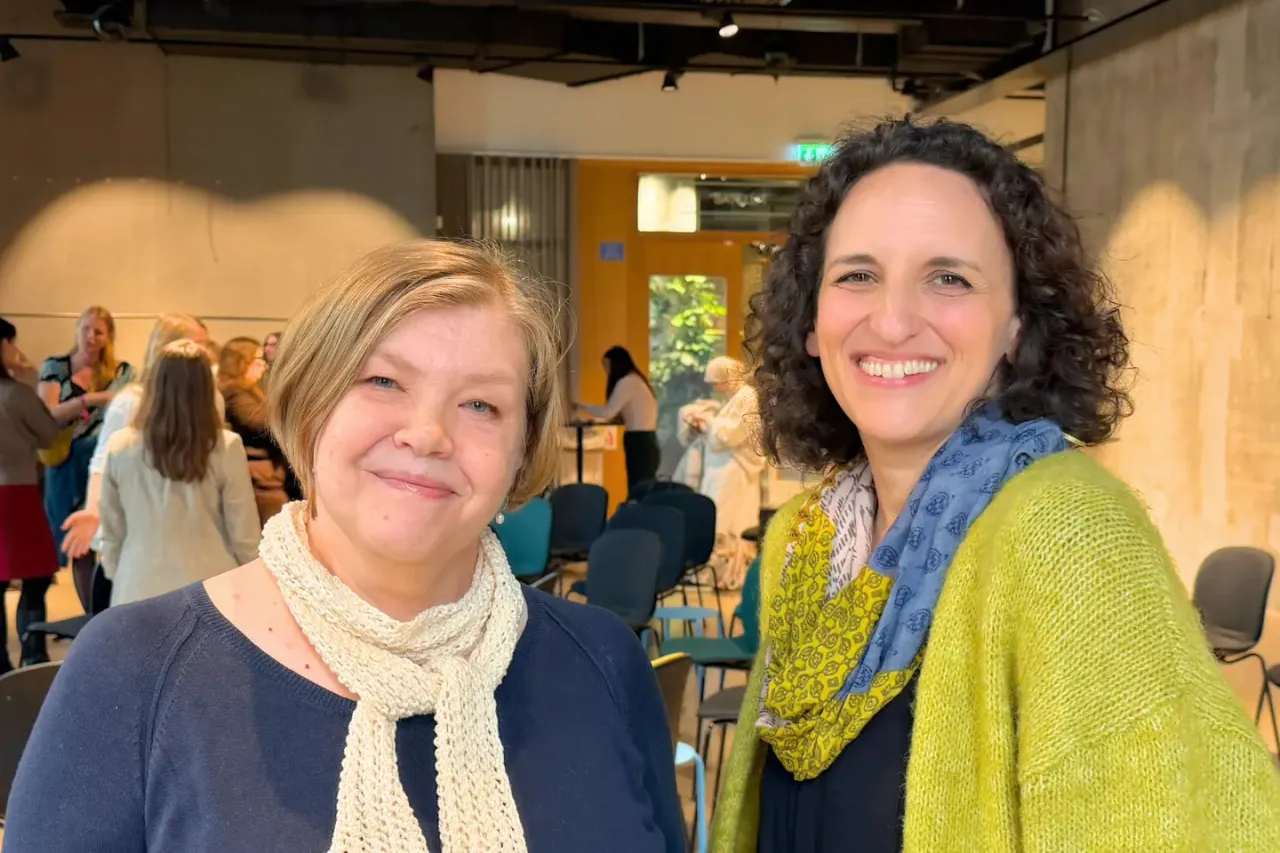
We’re Bojana and Natalia. We’re not from Sweden. Bojana is from Croatia. Natalia is from Russia. We both moved here as adults and had to learn Swedish the way you’re learning it now.
Natalia
Natalia arrived as a top student.
She had studied the grammar and passed the tests. Then an older woman at a grocery store asked her something simple, and she couldn’t follow.
Spoken Swedish, at normal speed and without warning, was nothing like the Swedish she had studied.
Bojana
Bojana did exactly what everyone says is the answer. Go to the country. Immerse yourself in the language. It should have been enough. It wasn’t. The words were there. But between knowing them and producing them with someone looking at her, waiting, a gap opened.
We had to take Swedish apart to learn it.
That’s why we can see where it breaks down for you.
Two stories. Same moment.We know this moment from the inside.
Not from a textbook.
Two Swedish teachers with qualifications
that are almost impossible to find.
We hold the highest formal qualification for teaching
Swedish to adults in Sweden.
Legitimerade gymnasielärare i svenska som andraspråk
22+ years teaching only adults, in every kind of Swedish school:
SFI, Komvux, university, private language schools, corporate programs
Arm, Massive Entertainment and Avalanche Studios are among the companies that bring us in for their international employees.
”What they worked on was the part no one else has reached. And that is what made the difference. To not only understand, but also be understood.”
You work directly with us, not hired instructors.
Is Stay in Swedish Right for You?
- Someone asks you something in Swedish. You understand most of it.
And still, you answer in English. - You’ve taken courses, used apps, and joined conversation groups where the advice was to speak more. And the next time someone
speaks Swedish to you, you still switch to English. - You walk away from conversations thinking:
I could have answered in Swedish. Why didn’t I? - You get by in Swedish, but you feel you can’t be yourself in it.
- You’re a complete beginner, or still in the early stages. This starts from the point where you already understand Swedish. The problem is using it.
- You want a grammar-heavy course with exercises and worksheets.
There are none here. Everything runs through speaking. - You want a course that prepares you for an exam.
This one prepares you for real conversations in Swedish. - You want to work on reading and writing. This is about staying in
a real Swedish conversation and taking part in it.
Still not sure if this is for you? Write to hej@likeanative.se, tell us a bit about
your Swedish, and we’ll help you work out whether it’s the right fit.
Using Swedish before you feel ready is uncomfortable at first.
Everyone in the first cohort took it into real conversations
while the program was still running. Here’s how they describe it.
”There’s no free lunch, embarrassment is the cost of entry. Especially in the beginning, you’re going to embarrass yourself a little bit. But that’s the cost of getting to the other side: becoming more comfortable, more relaxed. Not caring too much about making mistakes, and just focusing on keeping the conversation going.”
”Initially I felt awkward, too simple wordings, too short sentences. But afterwards I could see how people responded, fully accepting me, continuing the dialogue. And then it flowed.”
we’ve been there ourselves.
That’s why we know what kind of support you actually need. Bojana and Natalia
Everything You Get in Stay in Swedish
“SFI teaches for a test. Your class was the real world.”
I’ve been in Sweden so long, and I work in a Swedish culture, and I did SFI, Komvux. I did the whole thing. I felt like things were missing when I went into the real Swedish world, like something was missing.
SFI teaches for a test, not the real world. Your class was the real world.
From the beginning, I doubted myself a lot. But it has worked. What you taught is real. It’s 100% real. I tested it at work.
Ten Weeks From Now, You Stay in Swedish
The Four-Session Guarantee
Attend the first four sessions. If it isn’t what you needed,
send us one email and we refund the full amount.
To qualify, attend all four live. That is where you will know, and
this program only works if you show up for it.
frequently asked questions
Have Questions?
We believe you need to be 100% confident in your decision to join Stay in Swedish. Get honest answers to common questions.
How much Swedish do I need to have?
This program fits you if: You understand most of what people say to you in everyday Swedish. You can answer, even if it comes out slower or less correct than you'd like.
If that's you, your level fits, whether you speak a little or quite a lot.
Still not sure if this is for you? Write to hej@likeanative.se, tell us a bit about your Swedish, and we'll help you work out whether it's the right fit.
What exactly are you training that other courses aren't?
We're not teaching you more Swedish and hoping the freeze goes away. We train the Waiting Gap directly, the moment where it actually happens.
Through our Swedish Activation Method™ you get specific tools for finding your way through a conversation and staying in Swedish. It's a hands-on course, focused on speaking and real-life communication in Swedish.
After 22 years of teaching Swedish to adults, in every format that exists, we kept seeing the same moment. Nothing existed that addressed it, so we built this program ourselves.
The group is small enough that we see exactly where you get stuck, and we work with that directly.
What if it works for other people but not for me?
We understand the worry. You've done courses before and you're still stuck, so it's reasonable to wonder whether the problem is you. It isn't.
The freeze isn't a character flaw and it isn't a lack of effort. It happens because your brain has one tool that's fast and automatic (English), and another that's slower and new (Swedish). Under pressure it takes the fast one.
What changes it is training that moment directly, so you can find your way through a conversation and stay in Swedish instead of switching to English. That's what this program is built to do.
And you have the first four sessions to find out. Attend them live, and if it isn't what you needed, send us an email and we'll refund the full amount.
I've done SFI, Komvux, private courses/tutors, apps and conversation groups. How is this different?
Every approach you've tried did something real. Traditional courses gave you rules. Apps gave you repetition. Speaking groups gave you exposure.
But none of them trained you for the moment Swedish actually has to work in real life, with real pressure.
None of these paths were built for the Waiting Gap. They all assume the same thing: that if you know enough Swedish, or simply speak it often enough, the moment will take care of itself.
Here, you use it in your real conversations, and each week we go through what happened together: what worked, where you got stuck, what to do differently.
Is ten weeks really enough to change the way I speak?
Yes. The reason it works in that time is what we left out.
We spent more than 22 years each watching exactly where Swedish falls apart for adults, so we know what makes the biggest difference, and what can wait.
You don't suddenly become fluent. But conversations stop feeling dangerous. You stop switching to English and you stay in the conversation, because you know what to do instead of guessing.
The two phases are built for that too. In the first six weeks you learn the tools and start using them in your own conversations straight away.
In the last four weeks we go through your real conversations together: what worked, where you got stuck, what to do differently.
Emre, a participant in the Spring 2026 cohort, said it this way:
"A couple weeks into the course, I started understanding the system, maybe in three weeks, four weeks, I was like: 'Okay, I can always now default to Swedish.'"
I'd rather have a private teacher. Why a group?
One-to-one has its place. But it isn't what solves the Waiting Gap.
For more than twenty years we have taught one-to-one and group classes in parallel, so we know both formats well. Choosing a small group for this program was a deliberate decision, because for the Waiting Gap it does something one-to-one can't.
Here's what a group gives you that a private teacher can't.
You learn from each other, not only from us. Everyone in the room brings a different way of approaching the same moment, and you get perspectives that one teacher cannot give you on their own.
In a small group, you're not the only one under pressure. You hear other people's mistakes corrected, which is learning you get for free.
And when you're not the one speaking, you listen differently. When you speak, all your energy goes into speaking. When someone else speaks, you can relax and take more information in.
You also see people at your level, doing what you're doing. That is not available with a teacher who already speaks Swedish well.
Sonya and Emre were both in the Spring 2026 cohort of Stay in Swedish. This is what they said about learning in a group.
"I could see myself in other people. That was very uplifting." — Sonya Solo, Senior Animator, Russia
"Would have never happened alone, that's the thing." — Emre Er, Software Engineer, Turkey
Will everyone in the group be at my level?
Not identical, but close enough that nobody is lost and nobody is bored. What matters more is that everyone is working on the same thing.
You understand most of what people say to you in everyday Swedish. You can answer, even if it comes out slower or less correct than you'd like. And still, when someone speaks to you, you switch to English.
This isn't a course for beginners. It starts from the point where you already understand Swedish. The problem is using it.
We keep the group at a maximum of ten. Small enough that we see exactly where each person gets stuck, and small enough that everyone gets time to speak in every session.
I'm quite introverted. Speaking in a group is exactly what scares me.
Many of our students would say the same thing about themselves.
The group is small, and you don't need to perform for us. Creating a safe learning environment for our students has always been our highest priority.
And we're non-native speakers of Swedish too. We know what it feels like to have the words and not get them out, so we know what actually helps.
I've improved my Swedish before and then lost it. How is this course going to change that?
Most progress disappears in the weeks right after a course ends if you don't use it actively. That's why this program has two phases.
Weeks 1 to 6 are the training phase, where you learn the tools. Weeks 7 to 10 are the stabilization phase, where they settle. You use them in your real conversations, and each week we go through what happened together: what worked, where you got stuck, what to do differently.
Most courses end before you find out whether it works. This one doesn't.
Swedish pronunciation is my biggest problem. Do you work on that?
Yes, and it's the thing our students name most often.
We have taught in every format Swedish education offers, and we know how neglected pronunciation is. We decided to do something about that over 15 years ago, and we have each specialized in Swedish pronunciation ever since.
In our courses it is never a separate subject. It runs through everything. And in this course, where the whole focus is on speaking, that matters even more.
Pronunciation that is natural and easy to understand is often what decides whether you keep speaking Swedish and feel comfortable doing it, or switch to English. When people don't understand you and you have to repeat yourself, English starts to feel easier.
So we work on it throughout the ten weeks. We talk about it, we correct it, and you get feedback on it as you speak.
It's also one of the reasons we keep the group small. Your teacher hears you in every session, so at the end of the program you get an individual session where everything is gathered together: concrete things to work on, chosen for how you actually speak.
That session is included in the price and worth 1,250 SEK on its own
Why should I learn Swedish from you?
Because we learned Swedish as adults ourselves, the way you're learning it now.
Most Swedish teachers never had to work out why Swedish works the way it does. We did, because we had to. So when you get stuck, we know why, and we know what to do about it.
We're both certified (legtimerade) teachers of Swedish as a second language, with the highest formal qualification for teaching Swedish to adults in Sweden.
We have each been teaching for over 22 years, and only ever adults, in every format Swedish adult education offers (SFI, Komvux, university, private language schools, one-on-one, corporate programs).
You can read more about our background in the section called Your teachers.
We teach every session. No assistants, no hired coaches.
I'm already quite busy. Will I have time for this?
Yes. We designed this course for people with busy schedules, with work, family and everything else that already fills the week.
Everyone who has taken this course so far has been a busy professional with a full life outside work.
This is one of the reasons we keep the group small. In a group of ten everyone speaks in every session, and what you learn in a lesson is something you can use in your own conversations the same week.
Weeks 1 to 6: three hours a week, in two sessions. Weeks 7 to 10: an hour and a half a week.
That is also how the practice works.
You take what we trained in the session into the conversations you're already having. You are not adding hours to your week. You are changing what you do in the Swedish moments that were already there.
Is this online or in person?
Every session is live and online, on our own platform. You can join from anywhere.
What days and times are the sessions?
All sessions are live and online, outside regular office hours.
Weeks 1 to 6: one 90-minute lesson, Mondays 18:00–19:30, and one 90-minute practice and feedback session, Saturdays 10:00–11:30.
Weeks 7 to 10: one live session a week, Saturdays 10:00–11:30.
And every session is recorded, so you can catch up if you miss one.
What if I miss a session?
Sessions are recorded, so you can watch one you missed and pick up where the group is. Live is better, because you practice and we tell you what worked. But life happens, and missing a session won't put you behind.
Are the sessions in Swedish or English?
You will be speaking Swedish in every session. All the practice is in Swedish, always.
The only thing we decide together is how much English we use to explain things. Some groups want none from the start. Some want it at first. A group can run entirely in Swedish. This is one of the reasons we keep the group small: you have a say, and we're there as the experts to judge how far to push and when.
If you don't understand something, we explain it in English. What matters is that you understand it and can use it.
Can I pay through my employer or through my own business?
Yes.
For companies, the price is 6,600 SEK excluding VAT. We'll send an invoice made out to your employer/your business and we can provide documentation of your participation if your company needs it.
To reserve your place, write to hej@likeanative.se as soon as possible with the invoicing details. Otherwise we can’t guarantee your seat. Registration closes 4 September.
How does the refund work exactly?
Attend the first four live sessions, which is the first two weeks, and do the work with us. If you then feel this isn't what you needed, write to us and we'll refund the full amount.
To qualify, you have to attend the first four sessions live. Watching the recordings doesn't count.
What happens after I pay?
When you join, you create your account and go straight to the course page. All the information you need to start is there. Our first live lesson is Monday 7 September at 18:00.
If anything is unclear or you run into any problems, just write to us at hej@likeanative.se and we'll sort it out.
I have another question.
Write to us at hej@likeanative.se and we'll get back to you personally.
They Didn't Switch to English
Usually when I go to the pharmacy or store, I just speak English, because it's easier and I want to explain myself in a good way. So then, after a few lessons, I'm standing at a pharmacy talking about something with a person who works there, and then I suddenly realize that I'm speaking Swedish, which I completely didn't even think about. And I didn't change to English at all. I was just speaking Swedish like it was normal. And it was a big surprise for me.
The other day a girl asked me at ICA: 'Are you baking a lot this weekend?' And I was like: 'Ah, yes, because we have a student and then we are baking this and that.' I can feel now that I am much more confident.
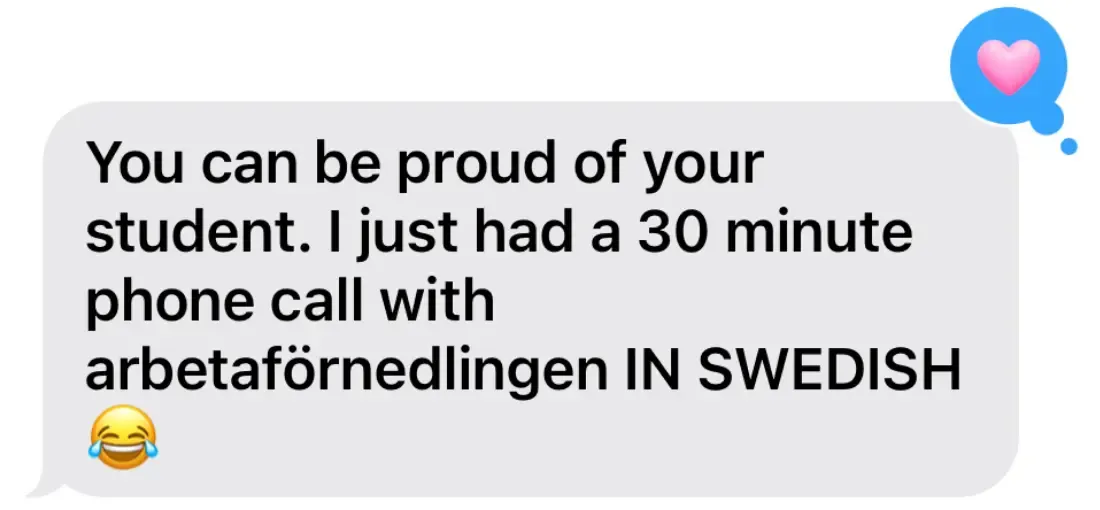
In week three, Raquel sent us this.
Information Management Specialist, Brazil
Swedish, or English Forever
"We don't need more learning. We need to start using our language. So it all clicked with me, and I wanted to just sign up and do something about my Swedish."
"At some point you have to decide. Either you speak, or you be silent, or speak in English forever. So I just decided."
You're two weeks away from knowing whether this works for you.
Attend the first four sessions live. That's where you'll know.
If it isn't what you needed, one email and we refund the full amount.
What Happens Next
When you join, you create your account and go straight to the course page. All the information you need to start is there. Our first live lesson is Monday 7 September at 18:00.